Learn to Pray: A Complete Guide to Salah
1. Introduction to Salah
What is Salah?
Salah (prayer) is the second pillar of Islam and the most important act of worship a Muslim performs. It is a direct connection between the worshipper and Allah (God). The word "Salah" comes from the Arabic root meaning "connection" or "link," reflecting the spiritual bond that is established during prayer.
Prayer was made obligatory upon every sane, adult Muslim during the Prophet Muhammad's (peace be upon him) miraculous night journey (Al-Isra wal-Mi'raj). It is the first act a person will be asked about on the Day of Judgment.
Why Five Daily Prayers?
Allah prescribed five daily prayers spread throughout the day and night. These prayers serve as spiritual anchors, keeping the believer mindful of God from dawn until nightfall. Each prayer has its own appointed time, creating a rhythm of worship that structures the Muslim's day:
- Fajr — The dawn prayer, before sunrise
- Dhuhr — The midday prayer, after the sun passes its zenith
- Asr — The afternoon prayer
- Maghrib — The sunset prayer, immediately after sunset
- Isha — The night prayer, after twilight disappears
The Prophet (peace be upon him) said: "The five daily prayers are like a river running by your door in which you bathe five times a day." (Sahih Muslim) Just as bathing cleanses the body, prayer purifies the soul.
2. The Adhan (Call to Prayer)
The Adhan is the Islamic call to prayer, proclaimed aloud before each of the five daily prayers. It was established during the time of the Prophet Muhammad (peace be upon him) and serves to announce the time of prayer and summon Muslims to the mosque. The first mu'adhin (caller to prayer) was Bilal ibn Rabah (may Allah be pleased with him).
Listen to the Adhan
Recited by Mishary Rashid Al-Afasy
اللَّهُ أَكْبَرُ ، اللَّهُ أَكْبَرُ
Allahu Akbar, Allahu Akbar
Allah is the Greatest, Allah is the Greatest
اللَّهُ أَكْبَرُ ، اللَّهُ أَكْبَرُ
Allahu Akbar, Allahu Akbar
Allah is the Greatest, Allah is the Greatest
أَشْهَدُ أَنْ لَا إِلَهَ إِلَّا اللَّهُ
Ash-hadu an la ilaha illallah
I bear witness that there is no god but Allah
أَشْهَدُ أَنْ لَا إِلَهَ إِلَّا اللَّهُ
Ash-hadu an la ilaha illallah
I bear witness that there is no god but Allah
أَشْهَدُ أَنَّ مُحَمَّدًا رَسُولُ اللَّهِ
Ash-hadu anna Muhammadan rasulullah
I bear witness that Muhammad is the Messenger of Allah
أَشْهَدُ أَنَّ مُحَمَّدًا رَسُولُ اللَّهِ
Ash-hadu anna Muhammadan rasulullah
I bear witness that Muhammad is the Messenger of Allah
حَيَّ عَلَى الصَّلَاةِ
Hayya 'alas-salah
Come to prayer
حَيَّ عَلَى الصَّلَاةِ
Hayya 'alas-salah
Come to prayer
حَيَّ عَلَى الْفَلَاحِ
Hayya 'alal-falah
Come to success
حَيَّ عَلَى الْفَلَاحِ
Hayya 'alal-falah
Come to success
اللَّهُ أَكْبَرُ ، اللَّهُ أَكْبَرُ
Allahu Akbar, Allahu Akbar
Allah is the Greatest, Allah is the Greatest
لَا إِلَهَ إِلَّا اللَّهُ
La ilaha illallah
There is no god but Allah
Note: For the Fajr (dawn) prayer, the following line is added twice after "Hayya 'alal-falah":
الصَّلَاةُ خَيْرٌ مِنَ النَّوْمِ
As-salatu khayrun minan-nawm
Prayer is better than sleep
3. The Iqamah
The Iqamah is the second call to prayer, given immediately before the congregational prayer begins. It is similar to the Adhan but shorter and delivered more quickly. Each phrase is said once (except "Allahu Akbar" at the beginning, which is said twice), and it includes the additional phrase "Qad qamatis-salah" (The prayer has begun).
اللَّهُ أَكْبَرُ ، اللَّهُ أَكْبَرُ
Allahu Akbar, Allahu Akbar
Allah is the Greatest, Allah is the Greatest
أَشْهَدُ أَنْ لَا إِلَهَ إِلَّا اللَّهُ
Ash-hadu an la ilaha illallah
I bear witness that there is no god but Allah
أَشْهَدُ أَنَّ مُحَمَّدًا رَسُولُ اللَّهِ
Ash-hadu anna Muhammadan rasulullah
I bear witness that Muhammad is the Messenger of Allah
حَيَّ عَلَى الصَّلَاةِ
Hayya 'alas-salah
Come to prayer
حَيَّ عَلَى الْفَلَاحِ
Hayya 'alal-falah
Come to success
قَدْ قَامَتِ الصَّلَاةُ ، قَدْ قَامَتِ الصَّلَاةُ
Qad qamatis-salah, Qad qamatis-salah
The prayer has begun, The prayer has begun
اللَّهُ أَكْبَرُ ، اللَّهُ أَكْبَرُ
Allahu Akbar, Allahu Akbar
Allah is the Greatest, Allah is the Greatest
لَا إِلَهَ إِلَّا اللَّهُ
La ilaha illallah
There is no god but Allah
4. Preparation for Prayer
Wudu (Ablution)
Before performing Salah, a Muslim must be in a state of ritual purity by performing Wudu (ablution). Wudu involves washing specific body parts in a prescribed order:
- Make the intention (niyyah) in your heart to perform Wudu.
- Say "Bismillah" (In the name of Allah) before beginning.
- Wash both hands up to the wrists three times.
- Rinse the mouth three times, swirling the water.
- Sniff water into the nostrils and blow it out three times.
- Wash the entire face three times (from hairline to chin, ear to ear).
- Wash both arms from fingertips to elbows three times, starting with the right.
- Wipe the head with wet hands once (from front to back and back to front).
- Wipe both ears with wet fingers once.
- Wash both feet up to the ankles three times, starting with the right.
Facing the Qibla
All prayers must be performed facing the Qibla, the direction of the Kaaba in Makkah, Saudi Arabia. Muslims worldwide face this direction as a unified expression of worship. You can determine the Qibla direction using a compass, a smartphone app, or by asking at your local mosque.
The Intention (Niyyah)
Before beginning any prayer, you must make the intention in your heart. The niyyah is not spoken aloud; it is a conscious mental resolve specifying which prayer you are about to perform. For example, before Dhuhr, you would intend in your heart: "I am performing the four fard rakahs of Dhuhr prayer, for Allah, facing the Qibla."
Place and Clothing
Prayer should be performed in a clean place. Many Muslims use a prayer mat (musalla). Men must cover at minimum from the navel to the knees. Women must cover their entire body except the face and hands. Clothing should be clean and modest.
5. The Five Daily Prayers
Each of the five daily prayers consists of a specific number of units (rakahs). Some rakahs are obligatory (fard) and some are strongly recommended (sunnah). Below is a detailed breakdown of each prayer.
Fajr (Dawn Prayer)
- Sunnah before: 2 rakahs (strongly emphasized, Sunnah Mu'akkadah)
- Fard (obligatory): 2 rakahs
- Recitation: Recited aloud by the imam in congregation.
Dhuhr (Midday Prayer)
- Sunnah before: 4 rakahs (Sunnah Mu'akkadah)
- Fard (obligatory): 4 rakahs
- Sunnah after: 2 rakahs (Sunnah Mu'akkadah)
- Recitation: Recited silently.
Asr (Afternoon Prayer)
- Sunnah before: 4 rakahs (optional, non-emphasized Sunnah)
- Fard (obligatory): 4 rakahs
- Recitation: Recited silently.
Maghrib (Sunset Prayer)
- Fard (obligatory): 3 rakahs
- Sunnah after: 2 rakahs (Sunnah Mu'akkadah)
- Recitation: First two rakahs recited aloud, third rakah recited silently.
Isha (Night Prayer)
- Fard (obligatory): 4 rakahs
- Sunnah after: 2 rakahs (Sunnah Mu'akkadah)
- Witr: 3 rakahs (or 1 rakah) — Witr is highly emphasized (wajib according to the Hanafi school).
- Recitation: First two rakahs recited aloud, last two rakahs recited silently.
6. Components of a Rakah
A rakah (unit of prayer) consists of a sequence of physical positions and recitations. Below is every component in order, with the full Arabic text, transliteration, and English translation.
6a. Standing (Qiyam) — Opening Takbir
Stand upright facing the Qibla. Raise both hands to the level of the ears (men) or shoulders (women) and say the opening Takbir (Takbiratul-Ihram) to begin the prayer:
اللَّهُ أَكْبَرُ
Allahu Akbar
Allah is the Greatest
After the Takbir, place your right hand over your left hand on your chest (or below the navel according to some schools of thought).

Qiyam (Standing)
6b. Opening Supplication (Dua al-Istiftah)
After the opening Takbir, recite the opening supplication silently. This is recited only in the first rakah:
سُبْحَانَكَ اللَّهُمَّ وَبِحَمْدِكَ وَتَبَارَكَ اسْمُكَ وَتَعَالَى جَدُّكَ وَلَا إِلَهَ غَيْرُكَ
Subhanaka Allahumma wa bihamdika, wa tabaraka ismuka, wa ta'ala jadduka, wa la ilaha ghayruk
Glory be to You, O Allah, and praise be to You. Blessed is Your name, and exalted is Your majesty. There is no god but You.
6c. Ta'awwudh and Bismillah
After the opening supplication, seek refuge in Allah from Satan and then say Bismillah before reciting Al-Fatihah:
أَعُوذُ بِاللَّهِ مِنَ الشَّيْطَانِ الرَّجِيمِ
A'udhu billahi minash-shaytanir-rajim
I seek refuge in Allah from Satan, the accursed.
بِسْمِ اللَّهِ الرَّحْمَنِ الرَّحِيمِ
Bismillahir-Rahmanir-Rahim
In the name of Allah, the Most Gracious, the Most Merciful.
6d. Recitation of Surah Al-Fatihah
Surah Al-Fatihah (The Opening) is recited in every rakah of every prayer. It is the most essential recitation in Salah. The Prophet (peace be upon him) said: "There is no prayer for the one who does not recite the Opening of the Book." (Sahih al-Bukhari)
بِسْمِ اللَّهِ الرَّحْمَنِ الرَّحِيمِ
Bismillahir-Rahmanir-Rahim
In the name of Allah, the Most Gracious, the Most Merciful.
الْحَمْدُ لِلَّهِ رَبِّ الْعَالَمِينَ
Al-hamdu lillahi Rabbil-'alamin
All praise is due to Allah, Lord of all the worlds.
الرَّحْمَنِ الرَّحِيمِ
Ar-Rahmanir-Rahim
The Most Gracious, the Most Merciful.
مَالِكِ يَوْمِ الدِّينِ
Maliki yawmid-din
Master of the Day of Judgment.
إِيَّاكَ نَعْبُدُ وَإِيَّاكَ نَسْتَعِينُ
Iyyaka na'budu wa iyyaka nasta'in
You alone we worship, and You alone we ask for help.
اهْدِنَا الصِّرَاطَ الْمُسْتَقِيمَ
Ihdinas-siratal-mustaqim
Guide us along the Straight Path,
صِرَاطَ الَّذِينَ أَنْعَمْتَ عَلَيْهِمْ غَيْرِ الْمَغْضُوبِ عَلَيْهِمْ وَلَا الضَّالِّينَ
Siratal-ladhina an'amta 'alayhim, ghayril-maghdubi 'alayhim wa lad-dallin
The path of those You have blessed, not of those who have earned Your anger, nor of those who have gone astray.
After completing Al-Fatihah, say "Ameen" (O Allah, accept our prayer) — aloud in the prayers recited aloud, and silently in the silent prayers.
6e. Additional Surah or Verses
In the first two rakahs of every prayer, after reciting Al-Fatihah, it is Sunnah to recite an additional surah or a selection of Quranic verses. In the third and fourth rakahs, only Al-Fatihah is recited.
Commonly recited short surahs for beginners include:
- Surah Al-Ikhlas (112) — The Sincerity — a concise declaration of monotheism
- Surah Al-Falaq (113) — The Daybreak — seeking refuge in Allah from evil
- Surah An-Nas (114) — Mankind — seeking refuge in Allah from whispering evil
- Surah Al-Kawthar (108) — The Abundance — one of the shortest surahs
- Surah Al-Asr (103) — The Time — on the importance of faith and patience
Listen to Surah Al-Fatihah
Recited by Mishary Rashid Al-Afasy
6f. Bowing (Ruku)
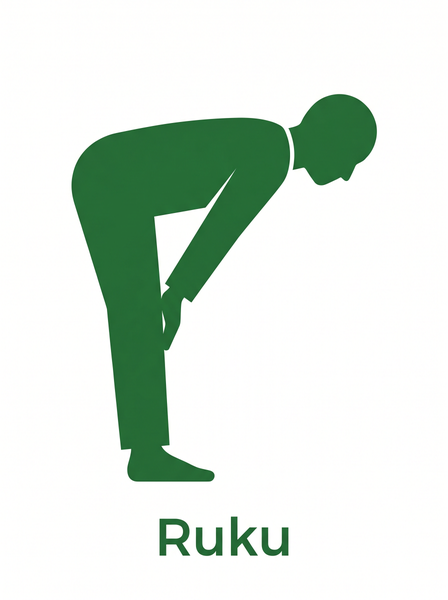
After the recitation, say "Allahu Akbar" and bow down (Ruku). Your back should be straight and parallel to the ground, with hands placed on your knees. In this position, recite the following three times:
سُبْحَانَ رَبِّيَ الْعَظِيمِ
Subhana Rabbiyal-Adheem
Glory be to my Lord, the Almighty.
(Recited three times)
Ruku (Bowing)
6g. Rising from Ruku
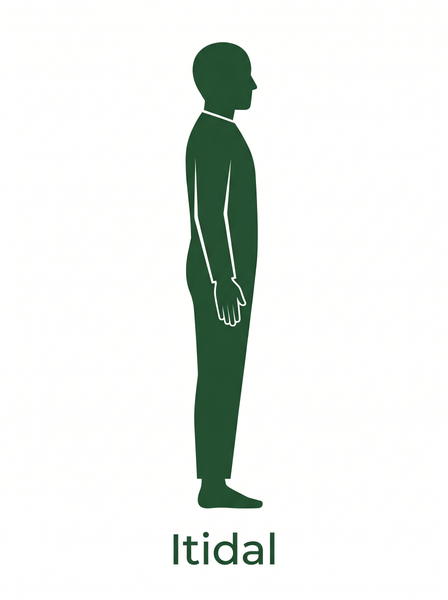
Rise from the bowing position back to standing upright. While rising, say:
سَمِعَ اللَّهُ لِمَنْ حَمِدَهُ
Sami'Allahu liman hamidah
Allah hears the one who praises Him.
Once standing fully upright, say:
رَبَّنَا وَلَكَ الْحَمْدُ
Rabbana wa lakal-hamd
Our Lord, and to You belongs all praise.
I'tidal (Standing after Bowing)
6h. Prostration (Sujud)
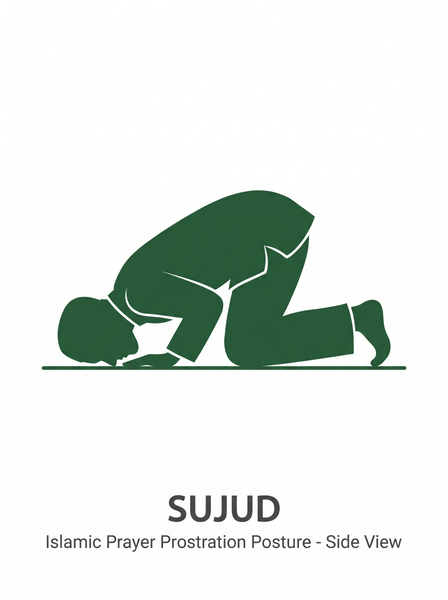
Say "Allahu Akbar" and go down into prostration (Sujud). Seven body parts must touch the ground: the forehead and nose, both palms, both knees, and the toes of both feet. In this position, recite the following three times:
سُبْحَانَ رَبِّيَ الْأَعْلَى
Subhana Rabbiyal-A'la
Glory be to my Lord, the Most High.
(Recited three times)
Sujud is the position in which a servant is closest to Allah. The Prophet (peace be upon him) said: "The closest a servant is to his Lord is when he is in prostration, so increase your supplications therein." (Sahih Muslim)
Sujud (Prostration)
6i. Sitting Between Prostrations (Jalsah)
Say "Allahu Akbar" and rise from prostration to a sitting position. Sit upright on the left foot with the right foot upright (toes pointing towards the Qibla). In this sitting position, recite:
رَبِّ اغْفِرْ لِي
Rabbighfir li
My Lord, forgive me.
You may also recite: "Rabbighfir li, warhamni, wahdini, warzuqni, wa'afini" (My Lord, forgive me, have mercy on me, guide me, provide for me, and grant me well-being).

Jalsah (Sitting Between Prostrations)
6j. Second Prostration
Say "Allahu Akbar" and go down into the second prostration. Recite the same supplication as in the first prostration:
سُبْحَانَ رَبِّيَ الْأَعْلَى
Subhana Rabbiyal-A'la
Glory be to my Lord, the Most High.
(Recited three times)
After the second prostration, this completes one full rakah. Say "Allahu Akbar" and stand up for the next rakah, or if this is the second or final rakah, remain seated for the Tashahud.
7. At-Tashahud (Testimony of Faith)
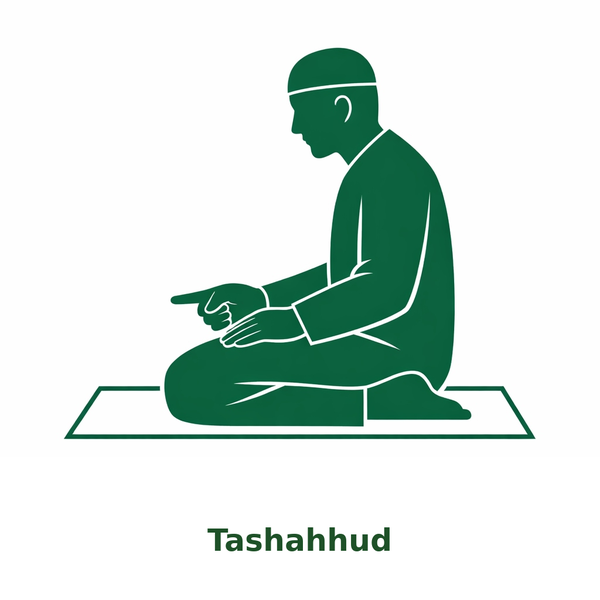
After every two rakahs, the worshipper sits and recites the Tashahud. In the sitting position, raise the right index finger when reciting the testimony of faith (Shahadah). The Tashahud is recited after the second rakah (in all prayers) and again in the final rakah (in prayers with 3 or 4 rakahs).
Tashahhud (Final Sitting)
التَّحِيَّاتُ لِلَّهِ وَالصَّلَوَاتُ وَالطَّيِّبَاتُ، السَّلَامُ عَلَيْكَ أَيُّهَا النَّبِيُّ وَرَحْمَةُ اللَّهِ وَبَرَكَاتُهُ، السَّلَامُ عَلَيْنَا وَعَلَى عِبَادِ اللَّهِ الصَّالِحِينَ، أَشْهَدُ أَنْ لَا إِلَهَ إِلَّا اللَّهُ وَأَشْهَدُ أَنَّ مُحَمَّدًا عَبْدُهُ وَرَسُولُهُ
At-tahiyyatu lillahi was-salawatu wat-tayyibat. As-salamu 'alayka ayyuhan-nabiyyu wa rahmatullahi wa barakatuh. As-salamu 'alayna wa 'ala 'ibadillahis-salihin. Ash-hadu an la ilaha illallah, wa ash-hadu anna Muhammadan 'abduhu wa rasuluh.
All greetings, prayers, and good things are for Allah. Peace be upon you, O Prophet, and the mercy of Allah and His blessings. Peace be upon us and upon the righteous servants of Allah. I bear witness that there is no god but Allah, and I bear witness that Muhammad is His servant and messenger.
If this is the middle Tashahud (after the second rakah in a 3 or 4-rakah prayer), stand up after reciting the Tashahud by saying "Allahu Akbar" and continue with the remaining rakahs. If this is the final Tashahud, continue sitting and proceed with the Salawat (Darood Ibrahim).
8. Salawat — Darood Ibrahim (Blessings upon the Prophet)
In the final sitting, after the Tashahud, recite the Salawat (also known as Darood Ibrahim). This is the prayer for blessings upon the Prophet Muhammad (peace be upon him) and his family, and upon Prophet Ibrahim (Abraham, peace be upon him) and his family.
اللَّهُمَّ صَلِّ عَلَى مُحَمَّدٍ وَعَلَى آلِ مُحَمَّدٍ كَمَا صَلَّيْتَ عَلَى إِبْرَاهِيمَ وَعَلَى آلِ إِبْرَاهِيمَ إِنَّكَ حَمِيدٌ مَجِيدٌ
Allahumma salli 'ala Muhammadin wa 'ala ali Muhammadin, kama sallayta 'ala Ibrahima wa 'ala ali Ibrahima, innaka Hamidun Majid.
O Allah, send blessings upon Muhammad and upon the family of Muhammad, as You sent blessings upon Ibrahim and upon the family of Ibrahim. Indeed, You are Praiseworthy and Glorious.
اللَّهُمَّ بَارِكْ عَلَى مُحَمَّدٍ وَعَلَى آلِ مُحَمَّدٍ كَمَا بَارَكْتَ عَلَى إِبْرَاهِيمَ وَعَلَى آلِ إِبْرَاهِيمَ إِنَّكَ حَمِيدٌ مَجِيدٌ
Allahumma barik 'ala Muhammadin wa 'ala ali Muhammadin, kama barakta 'ala Ibrahima wa 'ala ali Ibrahima, innaka Hamidun Majid.
O Allah, bestow Your grace upon Muhammad and upon the family of Muhammad, as You bestowed Your grace upon Ibrahim and upon the family of Ibrahim. Indeed, You are Praiseworthy and Glorious.
9. Tasleem (Ending the Prayer)
After completing the Salawat, the prayer is concluded with the Tasleem. Turn your head to the right and then to the left, greeting the angels on each side. This act of salam (peace) marks the official end of the prayer.
Turning to the Right
السَّلَامُ عَلَيْكُمْ وَرَحْمَةُ اللَّهِ
As-salamu 'alaykum wa rahmatullah
Peace be upon you and the mercy of Allah.
Turning to the Left
السَّلَامُ عَلَيْكُمْ وَرَحْمَةُ اللَّهِ
As-salamu 'alaykum wa rahmatullah
Peace be upon you and the mercy of Allah.
After the Tasleem, it is recommended to say "Astaghfirullah" (I seek forgiveness from Allah) three times, followed by various remembrances (adhkar) of Allah. Common post-prayer supplications include reciting "SubhanAllah" 33 times, "Alhamdulillah" 33 times, and "Allahu Akbar" 33 times, followed by "La ilaha illallahu wahdahu la shareeka lah, lahul-mulku wa lahul-hamdu wa huwa 'ala kulli shay'in qadir" once to complete 100.
10. Tahiyyatul-Masjid (Greeting the Mosque)
Tahiyyatul-Masjid is a voluntary prayer of two rakahs performed upon entering a mosque, before sitting down. The Prophet (peace be upon him) said: "If any one of you enters a mosque, let him not sit down until he has prayed two rakahs." (Sahih al-Bukhari and Sahih Muslim)
How to Pray Tahiyyatul-Masjid
- It consists of 2 rakahs, performed exactly like the first two rakahs of any prayer.
- Make the intention in your heart: "I am praying 2 rakahs of Tahiyyatul-Masjid for Allah."
- Perform the opening Takbir, recite Al-Fatihah and an additional surah in each rakah, perform Ruku and Sujud as described above.
- After the second rakah, sit for Tashahud and Salawat, then make Tasleem.
- If the obligatory prayer is about to begin (the Iqamah has been called), you should join the congregational prayer instead — it will suffice for Tahiyyatul-Masjid.
11. Quick Reference Table
The following table summarizes all five daily prayers, including the number of rakahs and whether the recitation is aloud or silent.
| Prayer | Time | Sunnah Before | Fard | Sunnah After | Silent / Aloud |
|---|---|---|---|---|---|
| Fajr | Dawn to sunrise | 2 | 2 | — | Aloud |
| Dhuhr | After zenith to mid-afternoon | 4 | 4 | 2 | Silent |
| Asr | Mid-afternoon to sunset | 4 (optional) | 4 | — | Silent |
| Maghrib | After sunset to dusk | — | 3 | 2 | Aloud (1-2), Silent (3) |
| Isha | After dusk to midnight | — | 4 | 2 + 3 Witr | Aloud (1-2), Silent (3-4) |
Key: "Aloud" means the imam recites Al-Fatihah and the additional surah audibly in congregational prayer. "Silent" means the recitation is done quietly, moving only the lips. When praying alone, the worshipper may choose to recite aloud or silently in the aloud prayers, but the silent prayers should always be recited silently.